


APA vs MLA vs Harvard: Which Citation Style Should You Use?

Choosing the wrong citation style is one of the most common — and easily avoidable — academic writing errors. Whether your institution requires APA, MLA, Harvard, Chicago, or another format, understanding the differences can save you hours of reformatting and protect your marks. This comprehensive guide explains when and how to use the three most popular referencing styles.
APA (American Psychological Association)
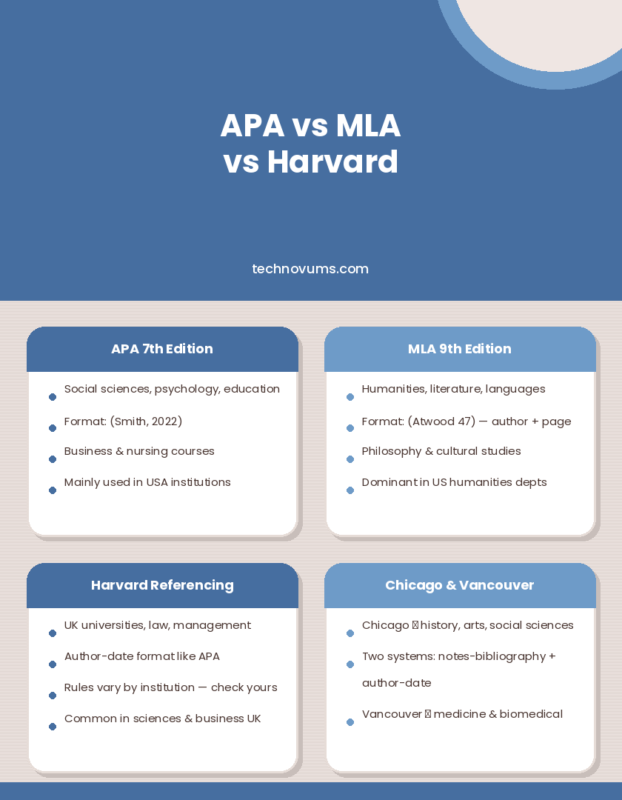
APA style is most commonly used in the social sciences — psychology, education, business, economics, and nursing. It uses an author-date in-text citation format: (Smith, 2022). Reference list entries include the author, year, title, and source. APA 7th edition is the current standard, which simplified some rules around DOI formatting and group author citations. If your subject is within the social or behavioural sciences, APA is almost certainly your required style.
MLA (Modern Language Association)
MLA is the standard for humanities disciplines including English literature, linguistics, philosophy, and cultural studies. Unlike APA, MLA uses a parenthetical author-page format: (Atwood 47). The 9th edition of MLA introduced a flexible “Works Cited” format that adapts to different source types using a core elements approach. MLA is predominantly used by US institutions and humanities departments globally.
Harvard Referencing
Harvard referencing is widely used across UK universities and is common in business, law, management, and scientific fields. It uses an author-date format similar to APA but with slightly different punctuation rules. Unlike APA and MLA, Harvard is not owned by a single organisation, so conventions can vary slightly between institutions. Always check your university’s specific Harvard guide.
Quick Comparison
Vancouver — Medicine, biomedical sciences
APA 7th Ed. — Social sciences, psychology, education, business (USA focus)
MLA 9th Ed. — Humanities, literature, languages, philosophy
Harvard — UK universities, business, law, management, sciences
Chicago — History, arts, some social sciences