


Top 10 Time Management Tips for Students with Heavy Assignments

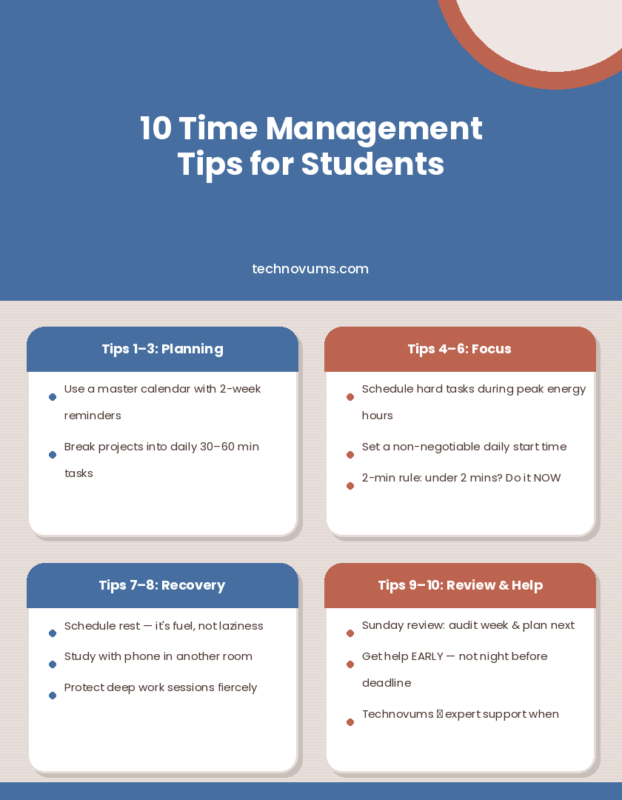
Between lectures, part-time jobs, social commitments, and a stack of deadlines, managing time effectively is one of the greatest challenges of student life. Poor time management does not just cost marks — it fuels stress, burnout, and poor mental health. These ten evidence-based strategies will help you reclaim your schedule and produce better work with less stress.
1. Use a Master Calendar, Not Just Your Memory
At the start of every semester, enter every assignment deadline, exam date, and scheduled assessment into a single digital calendar (Google Calendar, Notion, or similar). Set reminder alerts two weeks and one week before each deadline. Students who track deadlines visually miss them far less often.
2. Break Projects into Daily Tasks (Not Just Deadlines)
A 3,000-word essay due in two weeks is not “do the essay by Friday the 14th.” It is: find 10 sources (Day 1), build outline (Day 2), write introduction and section 1 (Day 3), and so on. Breaking large projects into 30–60 minute daily tasks removes the psychological paralysis that prevents students from starting.
3. Use the Pomodoro Technique for Deep Work
The Pomodoro Technique (25 minutes of focused work, 5-minute break, repeat four times then take a 20-minute break) is one of the most studied time management methods for students. It combats procrastination by reducing the commitment to short, manageable intervals and maintains focus by removing the temptation to “just check” social media.
4. Prioritise High-Value Tasks in Your Peak Hours
Identify whether you are a morning or evening person and schedule your most cognitively demanding tasks (writing, analysis, revision) during those peak performance windows. Reserve low-energy tasks (formatting, admin, printing) for your natural energy dips.
The Other Six Tips
Tip 5: Set a non-negotiable start time for assignments — do not wait for motivation
Tip 6: Use two-minute rule — if it takes under 2 minutes, do it immediately
Tip 7: Schedule recovery time — rest is not procrastination, it is fuel
Tip 8: Create a distraction-free study environment (phone in another room)
Tip 9: Review weekly — every Sunday, audit what you did and plan the next week
Tip 10: Get help early — if you are stuck, seek academic support immediately, not the night before