


How to Write a Research Paper in One Week (Without Panic)

Deadlines have a way of sneaking up on students. Whether you have been overwhelmed with coursework or simply underestimated the task, writing a research paper in one week is entirely achievable — if you have a plan. This guide gives you a day-by-day framework to produce a well-structured, properly cited research paper under tight time pressure.
Day 1 (Monday): Research and Source Collection
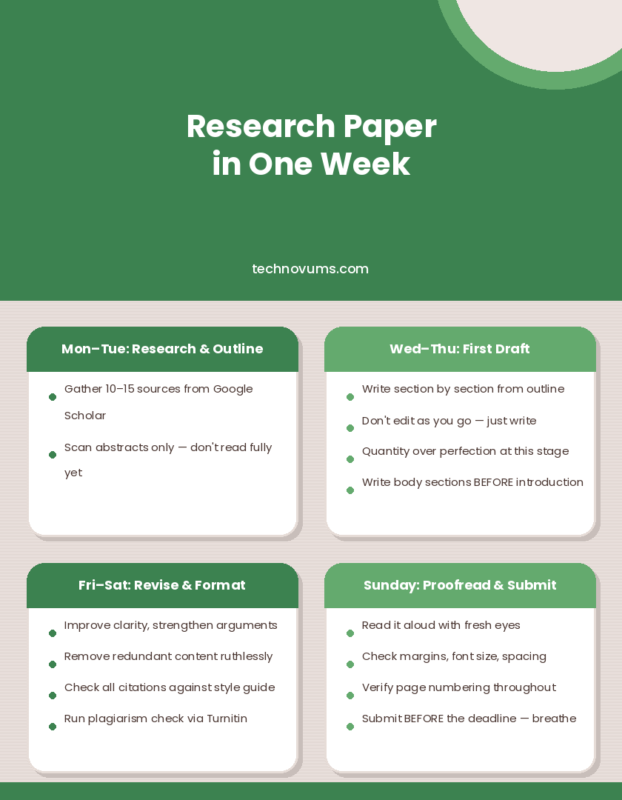
Spend your entire first day gathering sources. Use Google Scholar, your university library database, and credible government or institutional websites. Aim for 10–15 strong sources. Do not read them in full yet — scan abstracts, conclusions, and key sections. Export them all to a reference manager immediately so you do not waste time reformatting later.
Day 2 (Tuesday): Outline and Thesis Development
Before writing a single sentence of your paper, build a detailed outline. Define your thesis statement, then map out each section with bullet points of what evidence and arguments each will contain. A solid outline turns writing into a filling-in exercise rather than a creative struggle. This step is what separates students who finish on time from those who do not.
Days 3–4 (Wednesday–Thursday): First Draft
Write your first draft section by section following your outline. Do not edit as you go — just write. Aim for quantity over perfection at this stage. Write the body sections before the introduction, as your introduction will be stronger once you know exactly what your paper argues and concludes.
Days 5–6 (Friday–Saturday): Revise, Edit, and Format
Read your draft critically, improving clarity, strengthening arguments, and removing redundant content. Check your citation formatting against the required style guide. Ensure every claim is supported by a cited source. Then run a plagiarism check using Turnitin or a similar tool.
Day 7 (Sunday): Final Proofread and Submit
On your final day, proofread the complete paper with fresh eyes — ideally after a break. Read it aloud to catch awkward phrasing. Check formatting requirements: margins, font size, line spacing, and page numbering. Then submit before the deadline and breathe.