


What Is Academic Proofreading and Why Does It Matter?

You have spent weeks researching, drafting, and revising your assignment. Submitting without professional proofreading is like training for a marathon and stopping 200 metres before the finish line. Academic proofreading is not just spell-checking — it is a systematic review of your entire document for accuracy, clarity, and presentation quality.
Proofreading vs Editing: What Is the Difference?
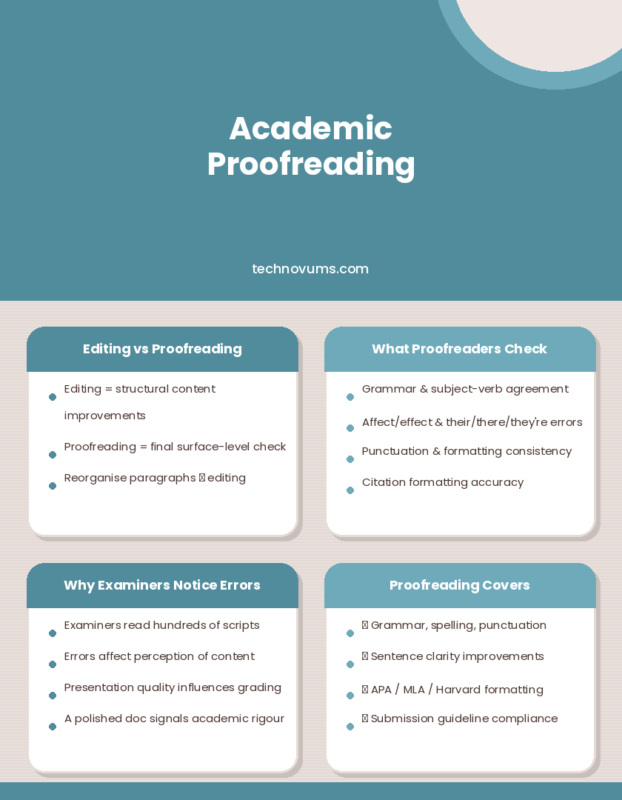
Many students conflate editing with proofreading, but they are distinct processes. Editing involves structural and content-level improvements — reorganising paragraphs, strengthening arguments, improving clarity of expression. Proofreading is the final stage, focusing on surface-level errors: spelling, grammar, punctuation, consistency of formatting, and citation accuracy. Both are essential, but proofreading should always be the last step before submission.
What Academic Proofreaders Look For
A professional academic proofreader reviews your work for grammatical errors (subject-verb agreement, tense consistency, run-on sentences), spelling mistakes that spell-check tools miss (affect/effect, their/there/they’re), punctuation errors, formatting inconsistencies (font sizes, heading styles, margins), and citation formatting errors. They also check that your bibliography matches your in-text citations exactly.
Why Examiners Notice Errors More Than You Think
Examiners read hundreds of assignments. Grammatical errors and formatting inconsistencies create a negative impression that affects how your content is perceived — even when the ideas themselves are excellent. Studies in educational assessment confirm that presentation quality influences grading even when marking criteria focus on content. A polished document signals professionalism and academic rigour.
What Professional Proofreading Covers
- Grammar, punctuation, and spelling correction
- Sentence structure and clarity improvements
- Citation and reference list formatting (APA, MLA, Harvard, Chicago)
- Consistency of academic voice and terminology
- Formatting alignment with submission guidelines
- Plagiarism awareness flags