


Literature Review Writing: The Ultimate Student Guide

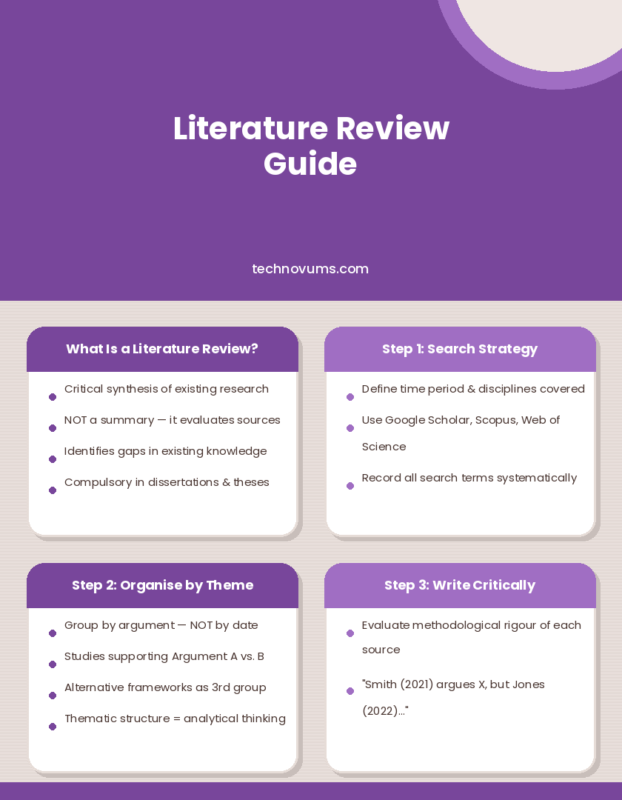
The literature review is one of the most intellectually demanding sections of any academic project. It is not simply a summary of what other scholars have written — it is a critical, thematic synthesis of existing knowledge that justifies your own research. This guide walks you through every stage of writing a strong, well-structured literature review.
What Is a Literature Review?
A literature review surveys, critically evaluates, and synthesises published research relevant to your topic or research question. It demonstrates your familiarity with the field, identifies gaps in existing knowledge, and positions your research within the broader academic conversation. It is a compulsory component of dissertations, theses, and most extended research papers.
Step 1: Define Your Scope and Search Strategy
Start by clearly defining the boundaries of your review. What time period will you cover? Which disciplines? Which databases will you search? Use keywords systematically in databases such as Google Scholar, Scopus, Web of Science, and your university library. Keep a record of your search terms and results — some academic programmes require you to document your search strategy in a PRISMA flowchart.
Step 2: Organise Sources Thematically, Not Chronologically
Many students make the mistake of summarising each source one by one in date order. Instead, group your sources by theme, argument, or methodology. For example: studies supporting Argument A, studies challenging Argument A, and studies proposing alternative frameworks. This thematic structure demonstrates analytical thinking rather than mere description.
Step 3: Write Critically, Not Descriptively
For every source you discuss, evaluate its methodological rigour, the strength of its evidence, its limitations, and how it relates to other work in the field. Use critical language: “While Smith (2021) argues X, this position is challenged by Jones (2022), who demonstrates Y using a larger longitudinal sample.” This is what distinguishes a strong literature review from a mediocre one.